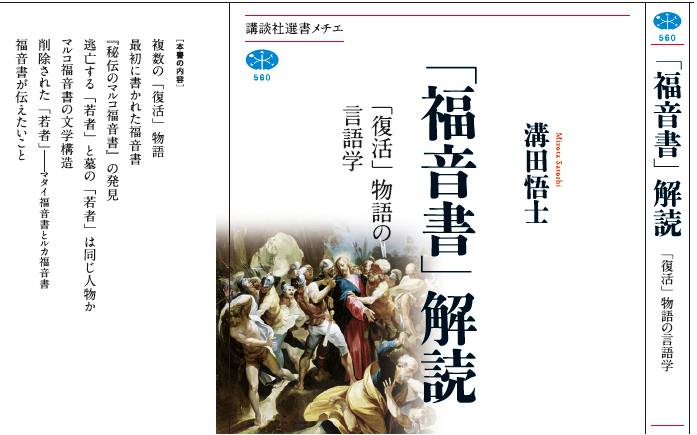
現在、首席司祭である私の著書『「福音書」解読』(講談社選書メチエ刊)の全編英訳を進めております(現在、約3分の1程度が完了)。完成後は、国際的な学術リポジトリであるSSRN(Social Science Research Network)にて公開し、世界中の研究者や探求者と共に、福音書の真意についての対話を開始する予定です。
I am currently working on a complete English translation of my book, “Deciphering the Gospels” (published by Kodansha Sensho Metier). With about one-third now finished, I plan to release the full work on SSRN (Social Science Research Network) upon completion. My aim is to initiate a global dialogue with researchers and seekers regarding the true meaning of the Gospels.
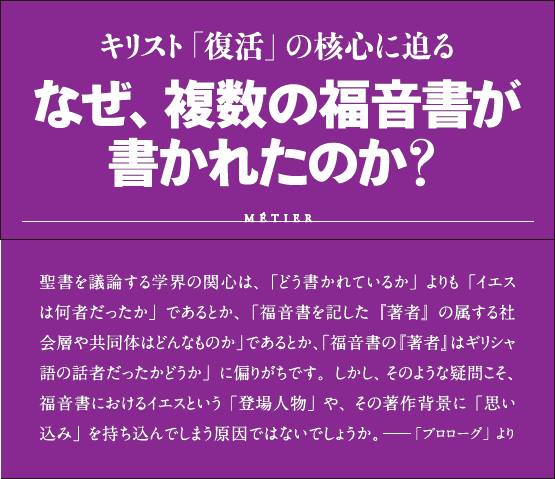
キリスト「復活」の核心に迫る
なぜ、複数の福音書が書かれたのか?
聖書を議論する学界の関心は、「どう書かれているか」よりも「イエスは何者だったか」であるとか、「福音書を記した『著者』の属する社会層や共同体はどんなものか」であるとか、「福音書の『著者』はギリシャ語の話者だったかどうか」に偏りがちです。しかし、そのような疑問こそ、福音書におけるイエスという「登場人物」や、その著作背景に「思い込み」を持ち込んでしまう原因ではないでしょうか。――「プロローグ」より
Getting to the Core of Christ’s “Resurrection”
Why Were Multiple Gospels Written?
The focus of biblical scholarship often leans more toward questions like “Who was Jesus?” or “What kind of social class or community did the ‘authors’ of the Gospels belong to?” or “Were they Greek speakers?” rather than looking at how the texts were written. However, isn’t it precisely these kinds of questions that cause us to project our own “preconceptions” onto the “character” of Jesus and the background of the Gospels’ creation?
—From the “Prologue”
村上陽一郎教授による書評
毎日新聞(2013年12月29日付)にて、科学史・科学哲学者である村上陽一郎氏は、溝田悟士著『「福音書」解読』を「復活」物語の成立過程をテクスト分析で解明する意欲作と評しました。村上氏は、共観福音書の記述のズレを推理小説のように解き明かす手法や、記号論を用いた深い考察を「並々ならぬ力量」と高く評価しています。本書に関する書評の詳細は、毎日新聞のデータベース等でご覧ください。
Book review by Professor Yoichiro Murakami
In the December 29, 2013 edition of The Mainichi Shimbun, Professor Yoichiro Murakami, a prominent historian and philosopher of science, hailed Satoshi Mizota’s Deciphering the Gospels as an ambitious work that clarifies the development of the Resurrection narratives through rigorous textual analysis. Murakami highly commended the author’s methodology—unraveling the discrepancies in the Synoptic Gospels with the intrigue of a detective mystery—and his deep semiotic insights, describing the work as a demonstration of “extraordinary caliber.” For further details of this review, please refer to The Mainichi Shimbun database.
英語版への序
本書の基となる理論が日本で初めて公にされたのは、今から13年前の2011年のことである。当時、日本の新約聖書学界において、本書が提示した「福音書の円環構造」や「連結デバイスとしての若者(ネアニスコス)」という仮説は、あまりに従来のパラダイムを逸脱していたがゆえに、既存の権威からは沈黙、あるいは困惑をもって迎えられた。
しかし、13年という歳月は、本理論が単なる一時の奇説ではなく、テキストの細部に宿る普遍的な言語学的真理であることを証明した。私は古代から現代に至る東西の膨大な解釈史を綿密に辿り直した上で、記号論やナラティブ理論といった言語学的枠組みを用い、共観福音書がそれぞれ「若者」「地震」「二人組」という固有のデバイスによって場面を連結させ、高度な「物語のリメイク(再構成)」を行っている事実を特定した。
特にマルコ福音書における、逃げた若者と空の墓の若者が「殉教した未来のペテロ」として同一化され、物語をガリラヤという起点へ回帰させる構造は、福音書が典礼暦の中で繰り返し読まれる「神の永遠」を体現したテキストであることを鮮やかに描き出している。
この13年間、日本語の壁の中に留まっていたこの先駆的な構造分析を、今ここに英語圏の学術コミュニティへと開放する。伝統的な様式批評が陥った断片化された解釈を超え、福音書を一つの完成された「動的な円環」として読み解く本稿の視座が、世界の聖書学に新たな対話を呼び起こすことを確信している。
Preface to the English Edition
This study is an English translation and adaptation of the author’s original work, first published in Japan in 2011. At that time, the hypothesis presented here—the “circular narrative structure of the Gospels” and the identification of the “young man” (neaniskos) as a narrative linking device—departed so radically from the conventional paradigms of Japanese New Testament scholarship that it was met with either bewildered silence or institutional resistance.
However, the passage of thirteen years has only served to prove that this theory is not a mere eccentricity, but a universal linguistic truth embedded in the text’s finest details. By meticulously tracing the history of interpretation from the ancient East to the modern West, and employing linguistic frameworks such as semiotics and narrative theory, I have identified a profound structural reality: that the Synoptic Gospels each utilize unique “linking devices”—the “Young Man” in Mark, the “Earthquake” in Matthew, and the “Two Men” in Luke—to perform sophisticated “narrative remakes” (reconfigurations).
Particularly in the Gospel of Mark, the identification of the young man who fled naked with the young man at the empty tomb as the “future martyred Peter” creates a literary Ouroboros. This structure, which returns the narrative to its Galilean beginning, vividly illustrates the Gospel as a text embodying the “Eternal Present” of God, intended for cyclical reading within the liturgical calendar.
By releasing this pioneering structural analysis—which has remained confined within the linguistic barrier of Japanese for over a decade—to the global academic community, I aim to transcend the fragmentation of traditional form criticism. I am confident that this perspective, which reads the Gospels as complete, “dynamic circles,” will spark a new and necessary dialogue in biblical studies worldwide.
お問い合わせと共同研究
論文の内容に関するお問い合わせ、講義のご依頼、あるいは共同研究のご相談など、どうぞお気軽にご連絡ください。
「講演の依頼や共同研究に関するご連絡を歓迎いたします」
E-mail: xqjhf345@yahoo.co.jp
Contact & Collaboration
For inquiries regarding the contents of the papers, or to discuss potential lecture invitations and research collaborations, please feel free to reach out.
“Correspondence regarding lectures or research collaborations is welcomed.”
Email: xqjhf345@yahoo.co.jp